After Will had suggested that moths would be one of the monitoring priorities for 2024, I naively asked to see the current moth list for the reserve having no idea that would send me down a rabbit hole of numerous record sources that were incomplete and, shall we say, different!
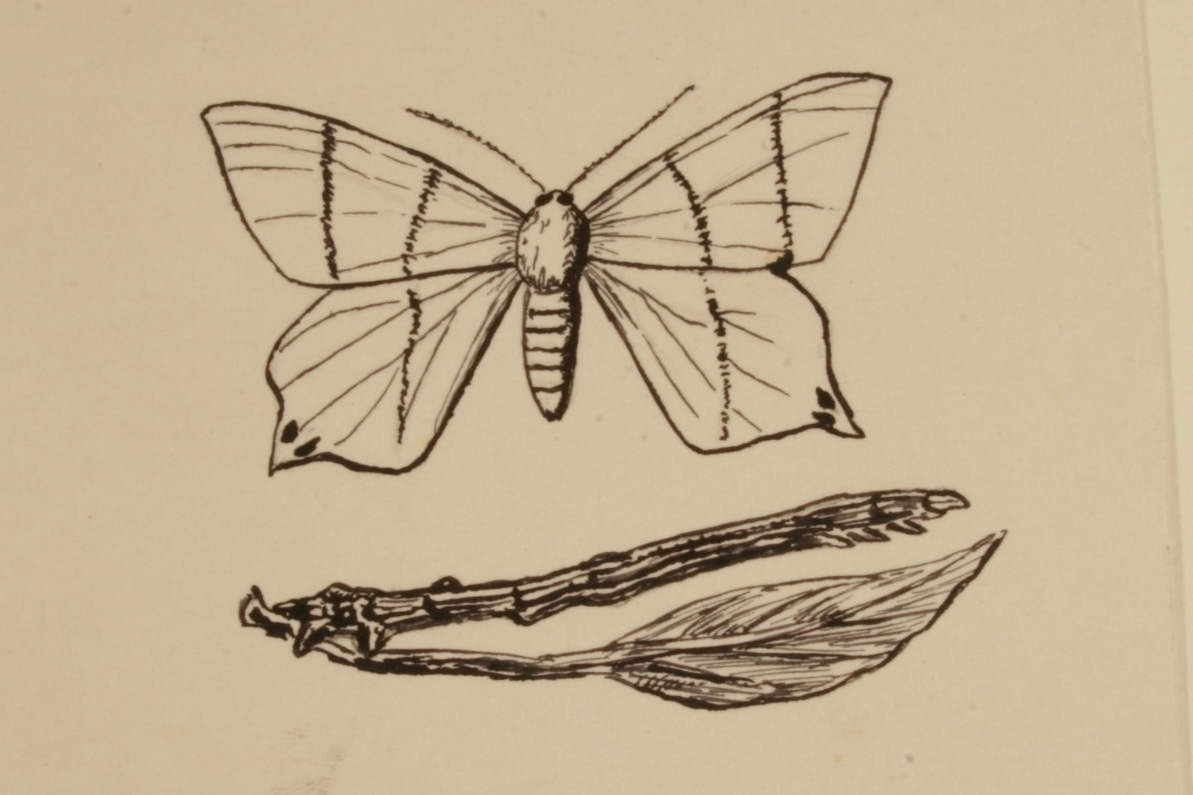
Ted’s illustrations of an adult Brimstone Moth and caterpillar (provided by Suzie Hanna)
Effectively there was no single or comprehensive source of moth records for the reserve nor a current systematic species list. Mike Hall compiled a consolidated list of moths for Wheatfen Broad in 1998 [1]. Roy Baker’s comprehensive compilation of records for the reserve, “The Fauna of The Wheatfen Nature Reserve” [2] included moths but that was last updated in 2019 and has gaps. The County Moth Recorder’s data, although containing the most recent records, was missing many of the earlier records. And then there were the discrepancies and … welcome to the rabbit warren.
What was soon apparent from the available records was that there has been a long and significant history of moth recording at Wheatfen although recording hasn’t been continuous with peaks and troughs over the years.
The earliest record appears to be a Sliver Y (Autographa gamma) from Two Acre Marsh recorded by Ted Ellis on the 1st September 1932. With records from 1932 until 1984, Ted recorded up to 167 new moth species for Wheatfen with the last being a Toadflax Pug (Eupithecia linariata) on the 25th August 1983 (recorded from a photo in his collection). The Brimstone Moth was first recorded for the reserve by JL Meuton in 1939 and Ted recorded the first Hummingbird Hawkmoth on 6th July 1944 “at Flox”
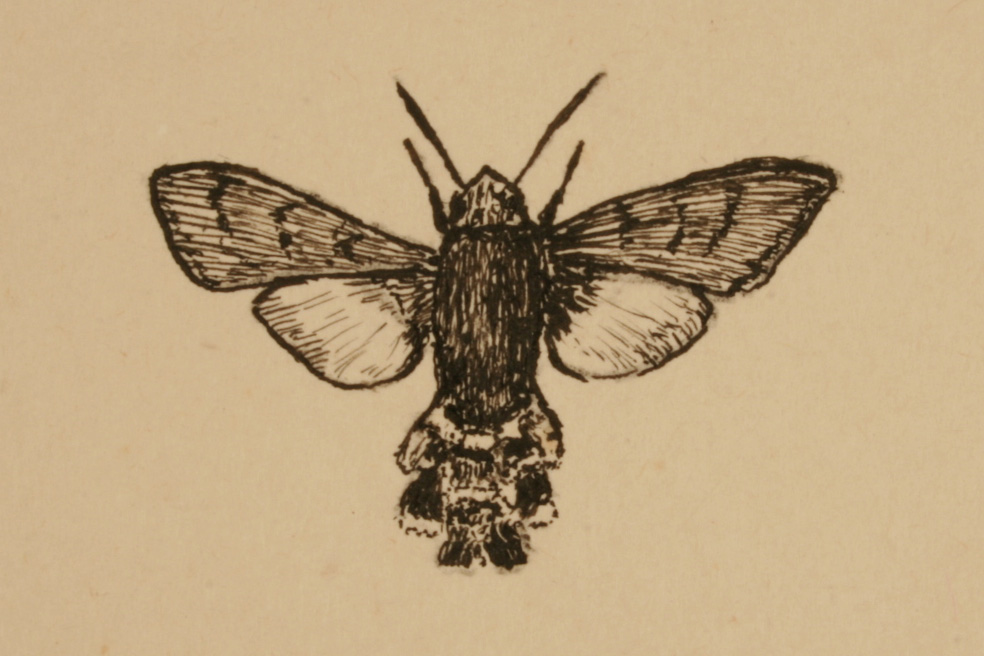
Ted’s illustrations of a Hummingbird Hawmouth (provided by Suzie Hanna)
Other early recorders included the previous owner, Captain M.J.D.Cockle, who was the first to record a Drinker (Euthrix potatoria) at Wheatfen on 12th March 1933 (although not specified, presumably a larva). Moth recording was popular in Victorian times however there don’t appear to be records that far back for Wheatfen – was that because no one recorded there or because records didn’t specify the particular location?
Reflecting on some of the early records reminded me how fortunate moth enthusiasts are today in terms of the resources available. Apart from the wide range of identification tools, from some excellent books through to websites (not least the invaluable Norfolk Moths site), smartphone apps and social media, the methods for finding moths have changed, for example the increasing use of light traps. The availability of electric light-traps has made the use of ‘sugaring’, where a concoction often featuring treacle and booze is painted onto trees etc to attract nectaring moths, much less common.
Roy Baker gives the following account of Ted, Ernest Daniels, B.A.Cooper and Russell Sewell trapping at the reserve in 1938 “… a group of Norfolk entomologists (EAE, ETD, BAC, RS) sugared trees on the west and south sides of Home Marsh-Broad Marsh using a mixture of black treacle and 1 tablespoon of rum in methylated spirit and amyl acetate on 9.8.1938 170 moths were collected, on 10.8.1938 278 moths and on 11.8.1938 208 moths on trees and 48 on stakes.” [2].
The Norfolk Moth Survey Newsletter [5] gives a brief, tongue in cheek, account of an event at Wheatfen on 18th September 1999 instigated by Phyllis Ellis which attempted to recreate a moth search “in the old fashioned way” using methods such as pit-traps to catch caterpillars as well as sugaring. Unfortunately the ‘old’ methods weren’t nearly as productive on this occasion and, in his ‘Warden’s Wildlife Report’ of 1999, David Nobbs reports that the ‘sugaring’ failed to attract any moths but apparently attracted plenty of harvestmen spiders [6]
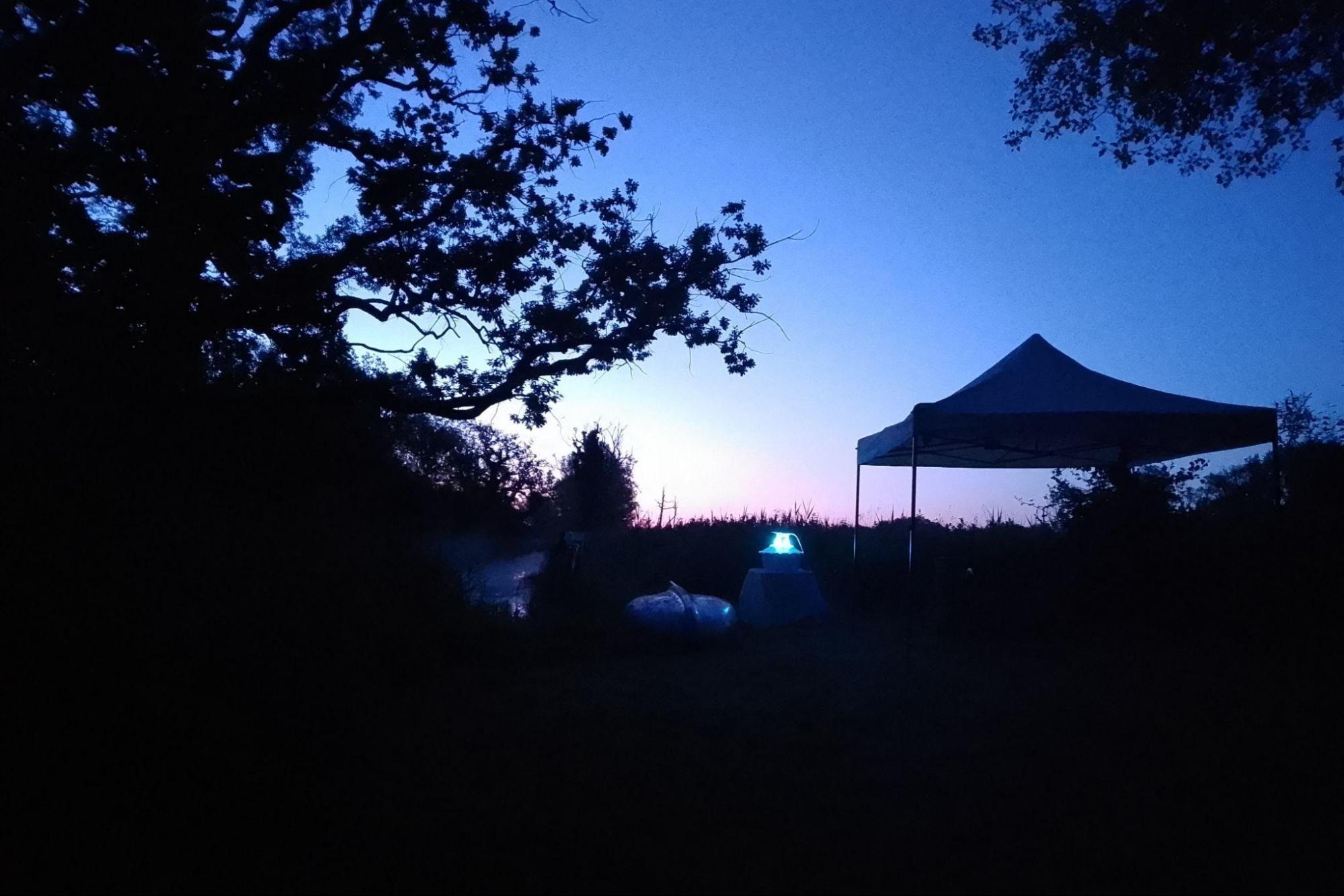
Moth trapping using an actinic lamp at Home Dyke in June 2024 (photo by Dave Jones)
Using light to attract moths is now a long established, non-lethal method of recording moths by exploiting the attraction many species have to light. Tim Peet was possibly the first person to make systematic use of a strong mercury vapour light at Wheatfen when he undertook a year long moth survey between June 1971 and October 1972.
Using light along with other methods such as sweep-netting and searching for larvae and pupae, Peet recorded up to 177 new species for Wheatfen and his findings, comparing Wheatfen as an inland wetland with Hickling Broad, are written up in the 1974 Norfolk & Norwich Naturalists’ Society Transactions [3].
Although the expression “like a moth to a flame” may be well known, exactly why some insects, including many moth species, come to light has long been a mystery. Previous theories, such as using the Moon for navigation aren’t totally convincing, however recently scientists have proposed a fascinating new theory that some insects, not just moths, effectively tilt their bodies towards light to align their flight. You can find more about their findings in a paper published in Nature Communications in 2024 [4]
Many of the records since the 1990’s are from Ken Saul and other members of the Norfolk Moth Survey who held sessions at the reserve over numerous years from 1990 to 1999 and from 2014 to 2019. In between, Derek Howlett & Roy Baker carried out a survey of winter moths in 2011-12. In recent years the annual Moth Night has become a regular event with a number of enthusiasts running traps in the evening to show the attendees. A number of individuals also run moth traps with permission and/or record daytime sightings.
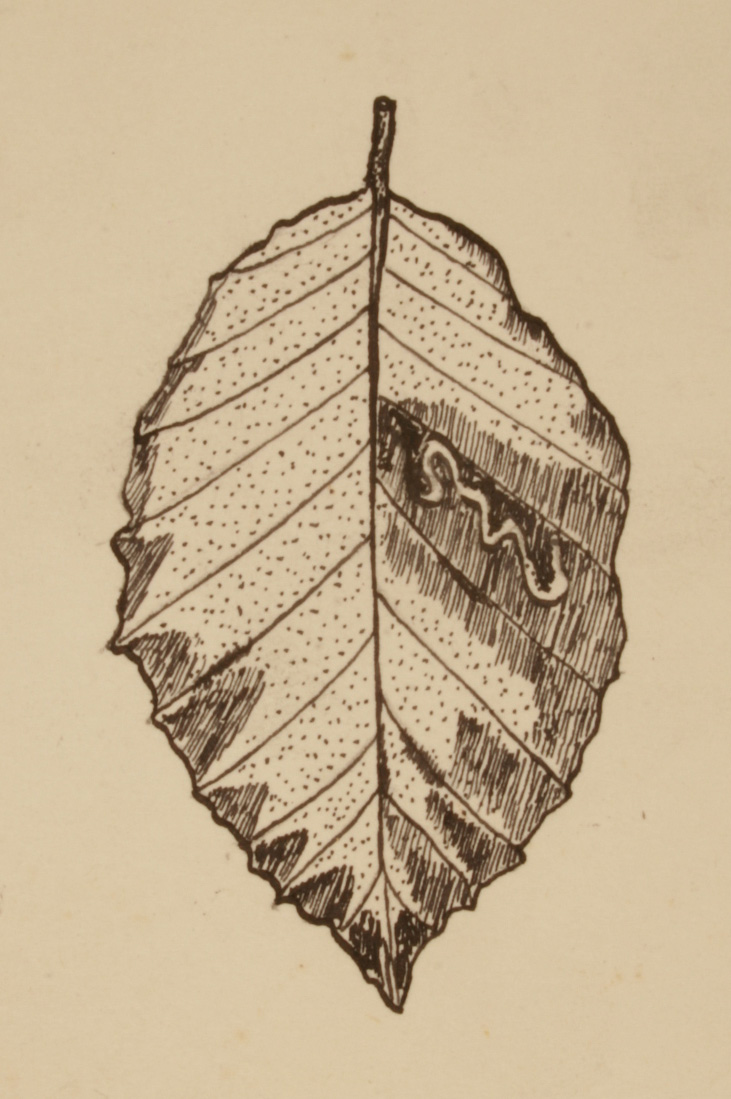
Ted’s illustration of a leaf-mine on Beech (kindly provided by Suzie Hanna). This is probably Stigmella tityrella, Small Beech Dot (not recorded for Wheatfen until 1998 by Ken Saul)
With records back to 2011, Stewart Wright has added more new species to the Wheatfen moth list than anyone other than Ted and Tim Peet. Aside from records in collaboration with others and verifying a number of earlier finds, Stewart has personally added 151 new species by the time of writing.
Many of these Stewart has recorded by searching during the day for ‘leaf-mines’ and other distinctive feeding signs that the larval stage (i.e. the caterpillar) of some species leave on their food plant. This method of searching is often the only way of finding and/or identifying some of the minute ‘micro moths’ and it also provides proof of breeding which other methods don’t necessarily provide. However it’s a method that requires patience and knowledge especially when the identification can rely on subtle features such as the pattern left by the caterpillar’s poo (or ‘frass’ as it should be called).
Take a closer look at leaves and you may find signs that a moth caterpillar has been feeding on or inside the leaf and it may still be resident as a larva or pupa. Have you ever wondered why some of the fallen autumn leaves have obvious green patches when the rest of the leaf is brown? During his survey in October 2024, Stewart pointed out these fascinating green ‘islands’ that can indicate where a moth larva has prevented the tree from absorbing all the resources from the leaf leaving the moth an area to feed on.
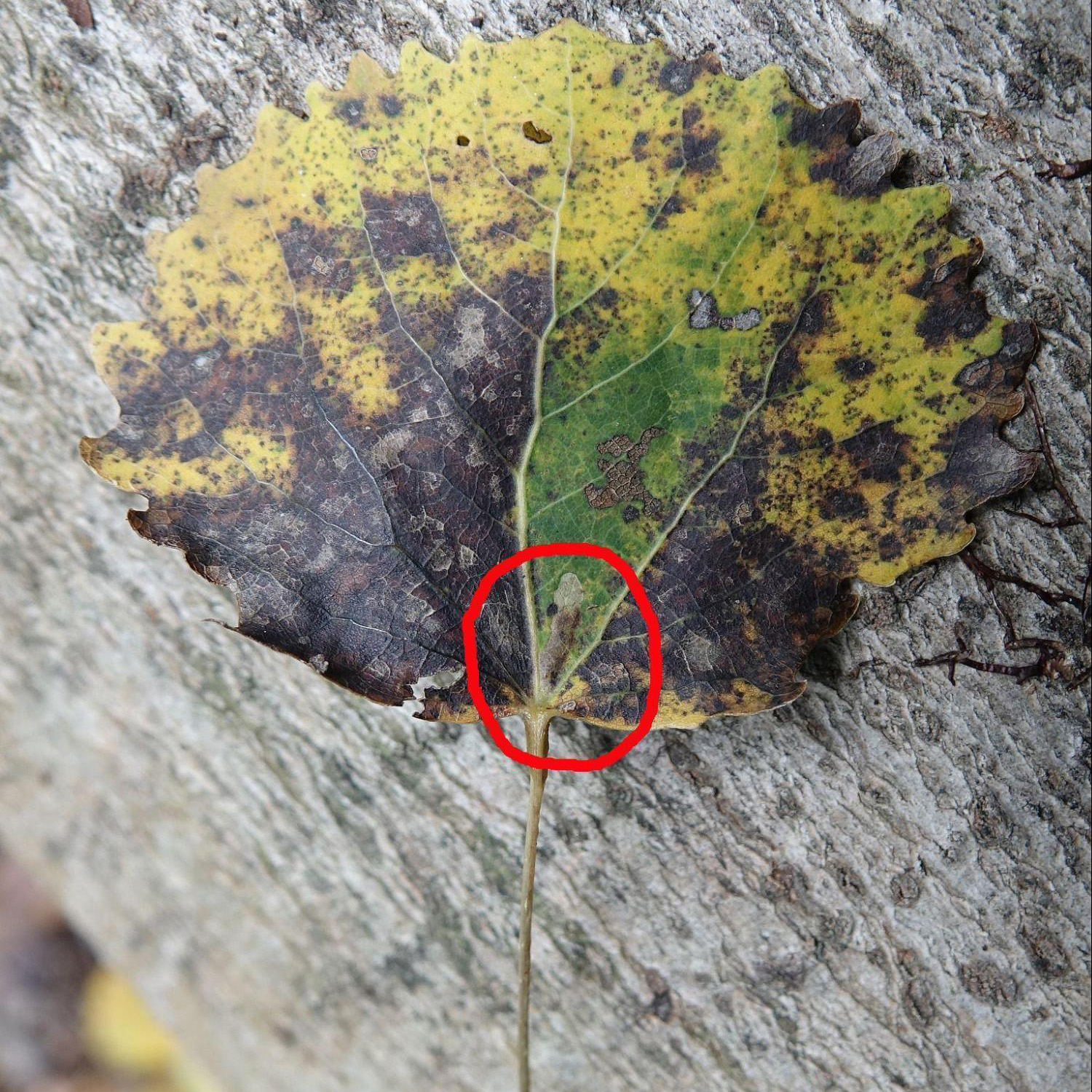
Aspen Dot (Ectoedemia argyropeza) leafmine at Wheatfen (photo by Dave Jones)
The moth records for the reserve include some notable species including Norfolk ‘firsts’ for Water-dropwort Brown (Depressaria daucella), the larvae of which were found by Hannah Breach & Kevin Radley in 2021, and Grey Aspen Tortrix (Epinotia cinereana) trapped in 2014 by the Norfolk Moth Survey group and confirmed using ‘gen det’ by Dave Hipperson.
There are also intriguing records in some sources for three species with no accepted Norfolk records: Silvery Arches (Polia hepatica), Map-winged Swift (Korscheltellus fusconebulosa) and Scarce Crimson & Gold (Pyrausta sanguinalis) however, without specimens, these cannot be confirmed. There are also records for some species, including the rare Marsh Carpet (Gagitodes sagittata), that unfortunately appear to be outside of the reserve boundary.
Having consolidated records from a number of sources, the species list for Wheatfen now stands at a total of 819 (see “NOTES ON THE RESERVE SPECIES LIST”). That’s almost a third of the estimated British total – an impressive amount but clearly there’s also a lot of potential to increase the reserve list. In 2024 a total of 321 species were recorded including 31 new species for the reserve and a further 18 species were recorded for the first time this century. Fourteen of the new species were attracted to light traps run at night but as a reminder that moths aren’t just found at night, the rest were found during the day.
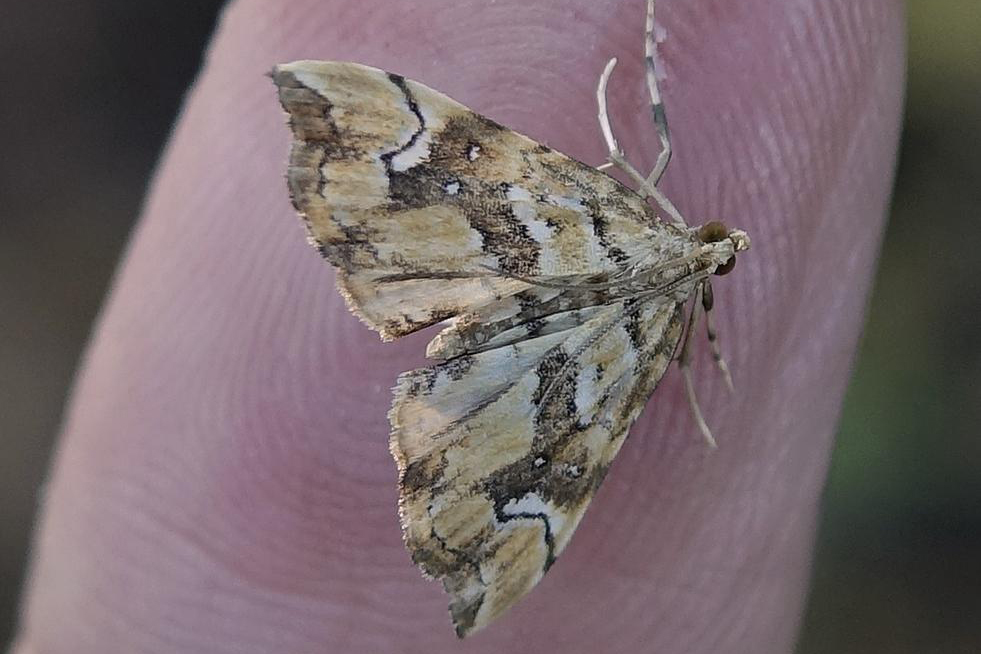
Marbled Fern (Musotima nitidalis) (photo by Dave Jones)
The most recent ‘day-flying’ addition was the Marbled Fern (Musotima nitidalis). The Marbled Fern is a small but attractive moth which is an ‘adventive’ being a native of Australia and New Zealand possibly introduced here from imported ferns. Since being recorded in Dorset in August 2009 this moth appears to have spread quickly and was first discovered in Norfolk at Horsford Woods in 2020. The Marbled Fern can easily be disturbed from bracken during the day especially in autumn and, following a suggestion from Stewart, a brief search in the wood on 17th October 2024 soon produced at least ten adults (and with the amount of bracken in the woods who knows how many there are in total?).
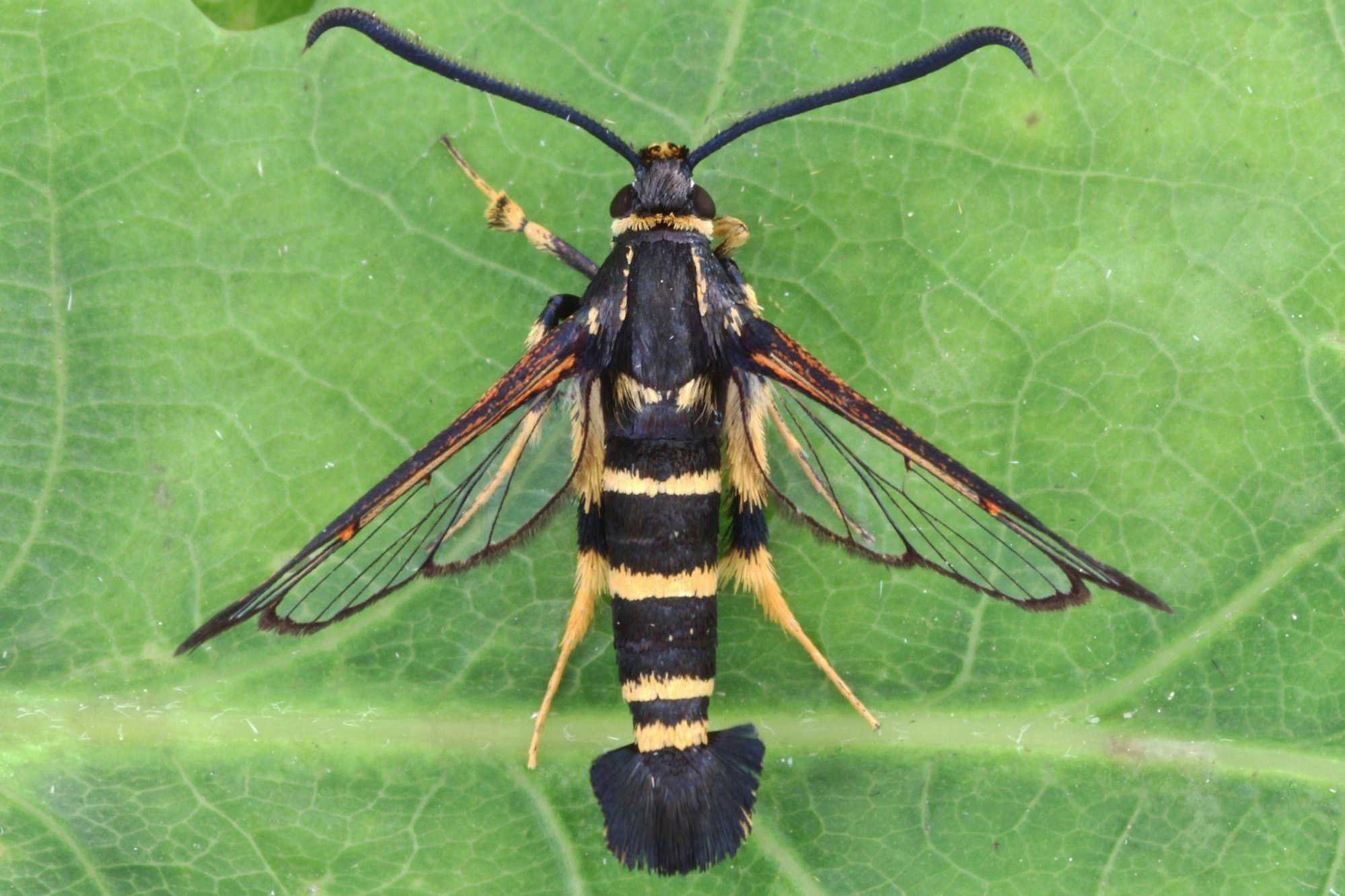
Yellow-legged Clearwing (Synanthedon vespiformis) (photo by Dave Jones)
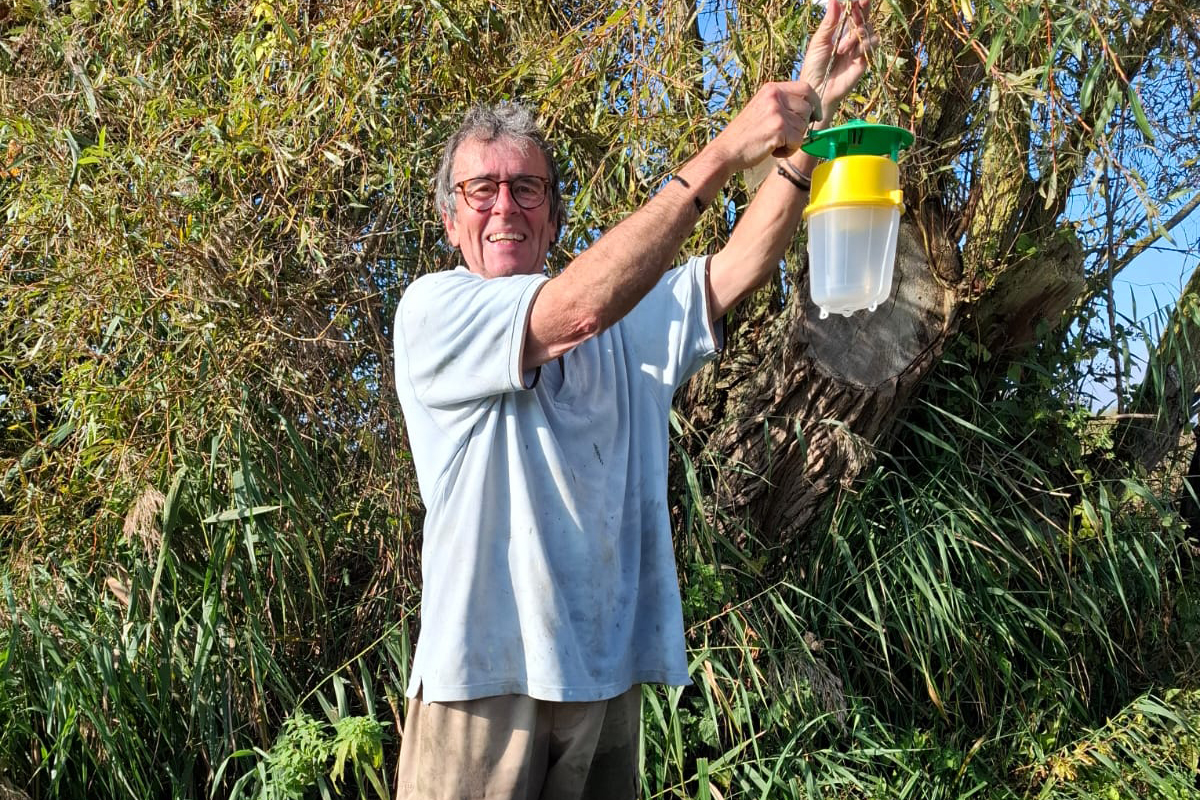
Two new species of clearwing moth for the reserve were recorded during the day in 2024 using synthetic pheromone lures that mimic the ‘scent’ of the female to attract males: Yellow-legged Clearwing (Synanthedon vespiformis) and Red-belted Clearwing (Synanthedon myopaeformis). Until lures became available, these day-flying moths that mimic wasps were considered to be scarce but the use of lures has revealed that many are actually relatively common.
If you saw someone dangling a small coloured plastic bucket in a bush and then lurking suspiciously in the vicinity then don’t worry that was probably me! However almost half of the new finds (thirteen in total) including the nationally scarce Gorse Leaf-miner (Phyllonorycter ulicicolella), were recorded by Stewart searching during the day for ‘leaf-mines’ and other larval feeding signs.
Stewart’s survey on 26th October found 79 species from larval signs (although a couple would need to be bred through to adults to absolutely confirm their identity). Remarkably this survey produced eleven new species for the reserve including Black-poplar Dot (Ectoedemia hannoverella), a rare species first recorded in Britain from Suffolk in 2002
Steve Ward has also been recording at the reserve for a number of years and trapping with Thomas Wood on the evening of 6th July 2024 recorded Mullein Wave (Scopula marginepunctata) – another first for the reserve and a scarce moth for Norfolk. Pauline and I had previously trapped occasionally at the reserve but in 2024 set ourselves an aim to run a light trap at least once a month – in the end we managed fourteen nights between February and November.

Reed Minor (Orthotelia sparganella) at Wheatfen (photo by Dave Jones)
Traps were run on the nights before a number of public events and produced some decent catches, the best being at least 355 moths of 114 species using two traps on the evening of 19th July before the Butterfly Walk which added four new species for the reserve including Reed Minor (Orthotelia sparganella) and, with only 38 previous Norfolk records, a Cottongrass Sedge-miner (Elachista albidella) confirmed by genitalia examination (gen det).
Traps were also run for the Wheatfen Wildlife Safari sessions and provided some ‘crowd pleasers’ including double figures of Garden Tiger (Arctia caja) from the evening of 6th August (it was great to see good numbers of this species that was once common but is now sadly considered to be declining nationally).
In contrast, the annual Moth Night in August was disappointing with a cool night after a day of constant heavy rain producing only 36 species (a total including Stewart’s daytime leaf-mine sightings).
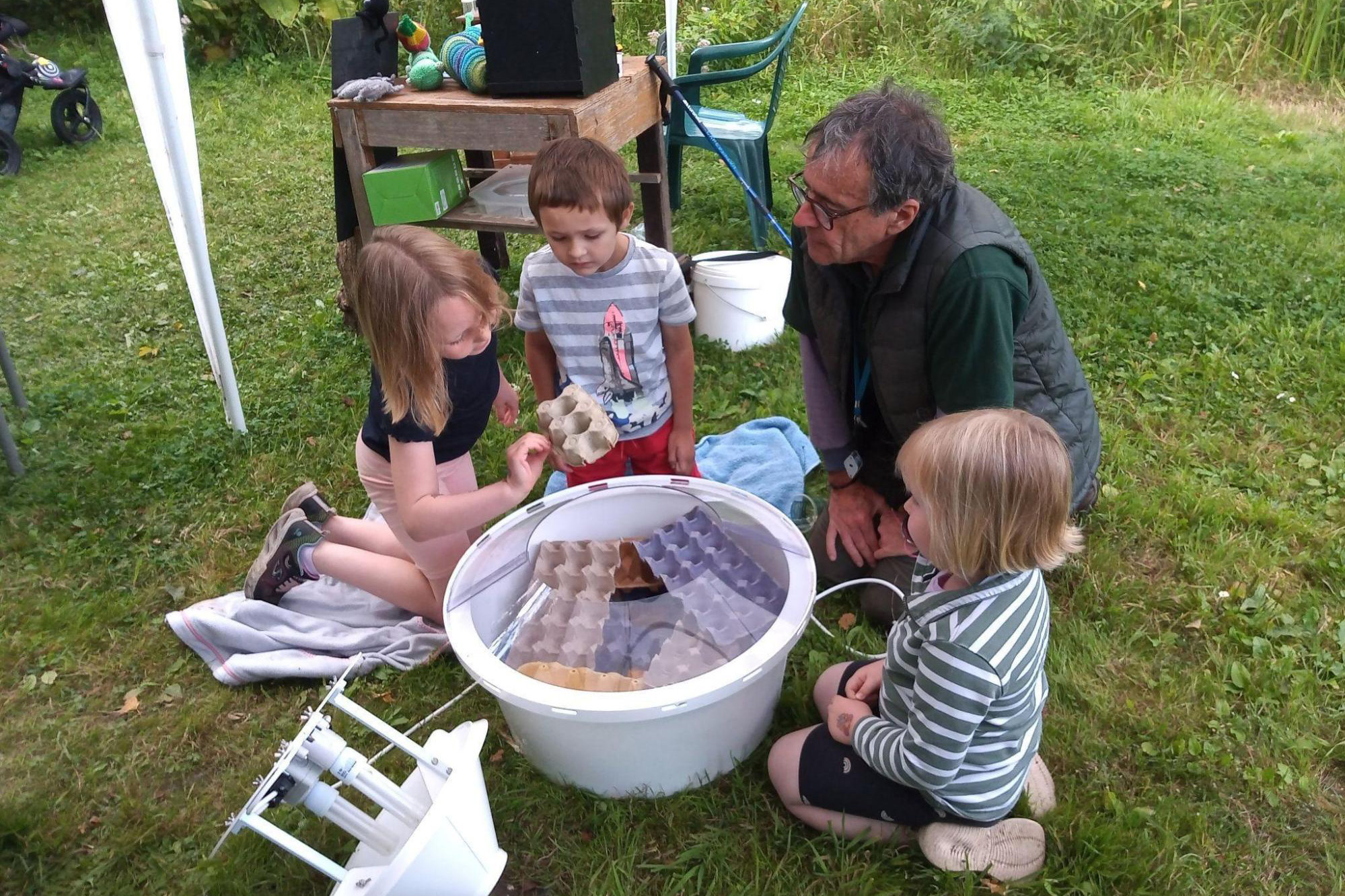
Opening the trap during a Wildlife Safari (photo by Pauline Montgomery)
The moth traps run to accompany the moth themed Lutestring music event in September were also quiet but did produce two more new species for the list including a Beet Moth (Scrobipalpa ocellatella), another nationally scarce species that was first recorded in Norfolk in 2019 but recently been found to be abundant in parts of the county where it may be exploiting beet crops. That night also produced the first Red-Green Carpet (Chloroclysta siterata) since Ted’s first reserve record in October 1939. The traps that night also demonstrated that it’s not just moths that will come to light and one of Steve Ward’s traps had to be shut down early when it was besieged by Hornets.
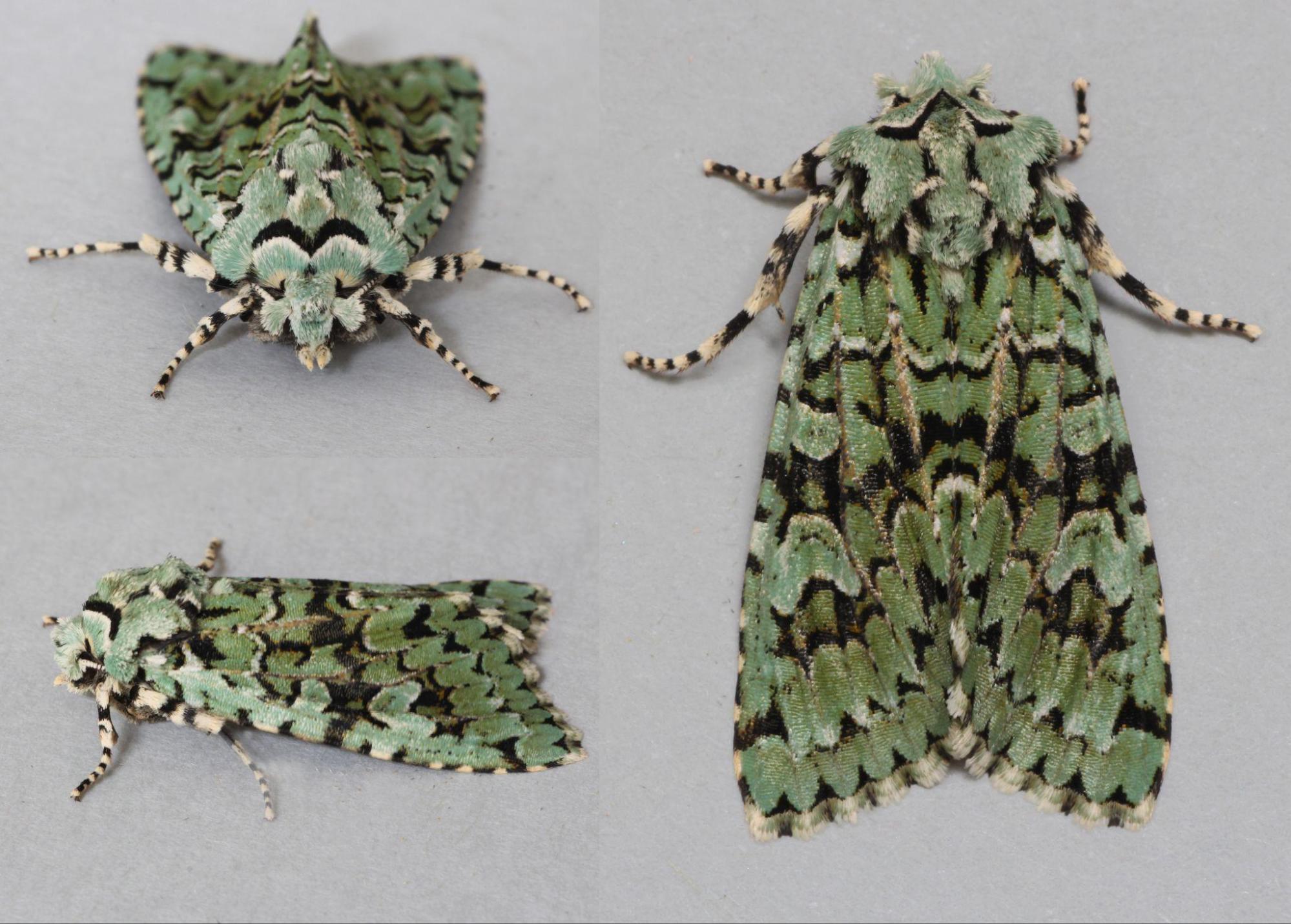
Merveille du Jour (Griposia aprilina) (photo by Dave Jones)
The traps for the October Wildlife Safari recorded some attractive autumn species including the wonderfully named Merveille du Jour (Griposia aprilina) which translates from the French as ‘marvel of the day’, a great name for this green moth that is perfectly camouflaged for resting on lichen. Surprisingly this was the first record for this relatively common moth at the reserve in the last fifty years (although that probably reflects the patchy nature of recording rather than being a significant ‘rediscovery’).

Delicate (Mythimna vitellina) at Wheatfen (photo by Dave Jones)
Although we only recorded thirteen species that night, three were new for the reserve: a Delicate (Mythimna vitellina) which is a species that was formerly only recorded in Britain as a migrant from the continent but may now be a resident breeder; a Sprawler (Asteroscopus sphinx) which like some other moths is named after the caterpillar, in this case because of the caterpillar’s habit of throwing back it’s head in defence, and a Late Reveller (Diurnea lipsiella). The Late Reveller proves that moth names aren’t always descriptive as this small, and frankly underwhelming, moth is pretty unlikely to keep the party going with any late night revelling!
Not every moth search during the year was a success. An attempt to attract the aptly named Scarce Vapourer (Orgyia recens) as part of an initial trial using pheromone lures provided by Butterfly Conservation failed.
This is a species that Ted referred to as a frequent flyer before World War Two and there is a photo of a larva in Ted’s photo collection from 1976 [2], however recent Norfolk records are now restricted to Catfield Fen and the Ant and Bure Marshes region and the species is currently classified as nationally rare, a Priority Species under the UK Biodiversity Framework Biodiversity Action Plan (BAP) and has been shortlisted as a Key Priority Species by the Norfolk & Suffolk Nature Recovery Partnership.
In the end we probably didn’t pick the best year to concentrate on moths with numbers generally being low (mirroring the disappointing results of this year’s Big Butterfly Count and other indicators of a generally poor year for butterflies and moths in 2024) but it was fun having the chance to share our fascination for moths and add something to the long history of “mothing” at Wheatfen.
And there must be much more to find on the reserve, not least the impressive Clifden Nonpareil (Catocala fraxini). Writing in 1974, Peet [3] suggested that this moth could be present, but fifty years later it’s still to appear at Wheatfen but with a recent increase in Norfolk records hopefully it’s only a matter of time.
Another intriguing potential for the reserve is the nationally rare Marsh Carpet (Gagitodes sagittata). Although there are apparently historic local records and the food plant, Common Meadow-rue (Thalictrum flavum), occurs there are no records of the moth for the reserve itself and possibly the tidal nature makes it an unsuitable habitat?
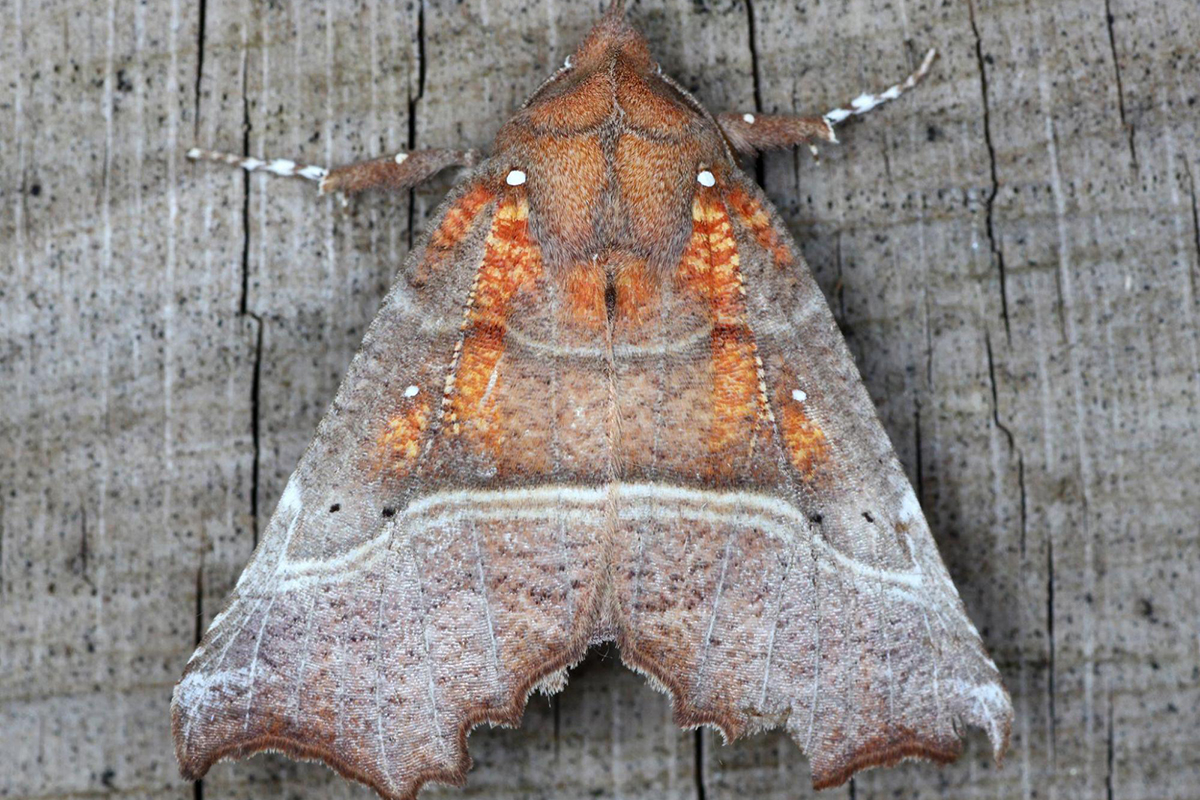
Herald (Scoliopteryx libatrix)(photo by Dave Jones)
And finally, just to prove that not all moth encounters are planned, a moth highlight that I missed seeing in the year was the discovery of a roost of Herald (Scoliopteryx libatrix) moths under the floor of the old office when it was dismantled in October. Like some butterflies, the Herald is a species that will over-winter as an adult, usually hibernating in a dark place.
The old office was productive again when Rebecca found a Many-plumed Moth (Alucita hexadactyla) on a dismantled panel on the 20th November – another addition to the moth list and ensuring Rebecca a place on the Wheatfen ‘first-finders’ honours board.
And on the subject of dark places – have I emerged from that rabbit hole clutching a definitive list for the reserve? Hopefully there is now a far more complete set of records with the County Moth Recorder having over 1,800 additional records for Wheatfen including many early records from Ted and his contemporaries.

Many-plumed Moth (Alucita hexadactyla) (photo by Dave Jones)
However there are probably still many gaps and old records to be discovered. I recently watched a video about the reserve produced around 2009 and narrated by David Nobbs, the former warden. The video includes segments on moths and features one species with no reserve ‘record’ and another species not officially recorded for the reserve until five years later.
David also commented on the impact of Horse Chestnut Leaf-miners (Cameraria ohridella) in his Warden’s Wildlife Report in 2006 [7] although the first ‘record’ for the reserve was from 2014. Another example of how records have somehow been overlooked was the recent ‘find’ of a 1995 record for Netted Ochre (Ypsolopha lucella) referred to in the Norfolk Moth Survey Newsletter [8] but not in the County records despite there being only five Norfolk records for this ‘Nationally Scarce’ species.
In compiling his work on the Wheatfen Fauna [2], Roy Baker drew on Ted’s archive and noted in his introduction that “many … records exist on scraps of paper and card” and numerous records in Baker’s work are attributed to Ted’s articles or photo collection but what else might be found with a deeper dive into Ted’s extensive archive of meticulous notes?
With another new species added so far in 2025 by Stewart, Pine Nut Moth (Cydia conicolana), the Wheatfen moth list currently stands at 819 but there is obviously plenty of potential to increase that total with new discoveries in the field and in the archives!
NOTES ON THE RESERVE SPECIES LIST
The species list can be consulted at the Reserve. The reserve total includes some species where acceptance would now require the adult specimen to be retained or photographed (grade 3) or confirmed by genitalia determination aka “gen.det.” (grade 4). Similar additional verification requirements apply to some leaf mines or other larval stages.
Where there is a record on the county database although the verification method is unknown, the species has been added to the reserve list if it is reasonably common (indicated by y* in the Reserve list). If these were omitted the reserve list would currently be 775 rather than 819.
Also included in the list but not counted in the species total are entries for ‘aggregates’ (these are used for recording purposes for similar species that cannot be reliably separated visually) and, for information, records for species that are listed in some sources but are apparent errors, uncertain (these include ‘unverified’ records, indicated by n*) or records that may be outside the reserve.
REFERENCES
[1] Mike Hall, “Wheatfen Broad – Norfolk Moth Records to 1998” [Norfolk Moth Survey, 1998?]
[2] The Ted Ellis Trust, “The Fauna Of The Wheatfen Nature Reserve 1930-2019: The Invertebrates vol 3: Butterflies and Moths” (compiled by Roy Baker, May 2001 last amended 2019)
[3] Peet, T.N.D., “Notes on the Moths of Hickling and Wheatfen Broads, with a systematic list of species” in the 1974 Norfolk & Norwich Naturalists’ Society Transactions, p156-166
[4] Fabian, Samuel.T., Sondhi, Y., Allen, P.E. et al. “Why flying insects gather at artificial light”. Nature Communications, 15, 689 (2024).
[5] Norfolk Moth Survey Newsletter, no 56 November 1999
[6] Friends of the Ted Ellis Trust Newsletter 2000
[7] Friends of the Ted Ellis Trust Newsletter 2007
[8] Norfolk Moth Survey Newsletter, no 48 November 1995
Sarah (Evans) and I are booked onto the dragonfly walk his Saturday but neither of us will be able to make it. If it’s oversubscribed and you can resell the tickets we’d be very pleased. We hope it goes well.