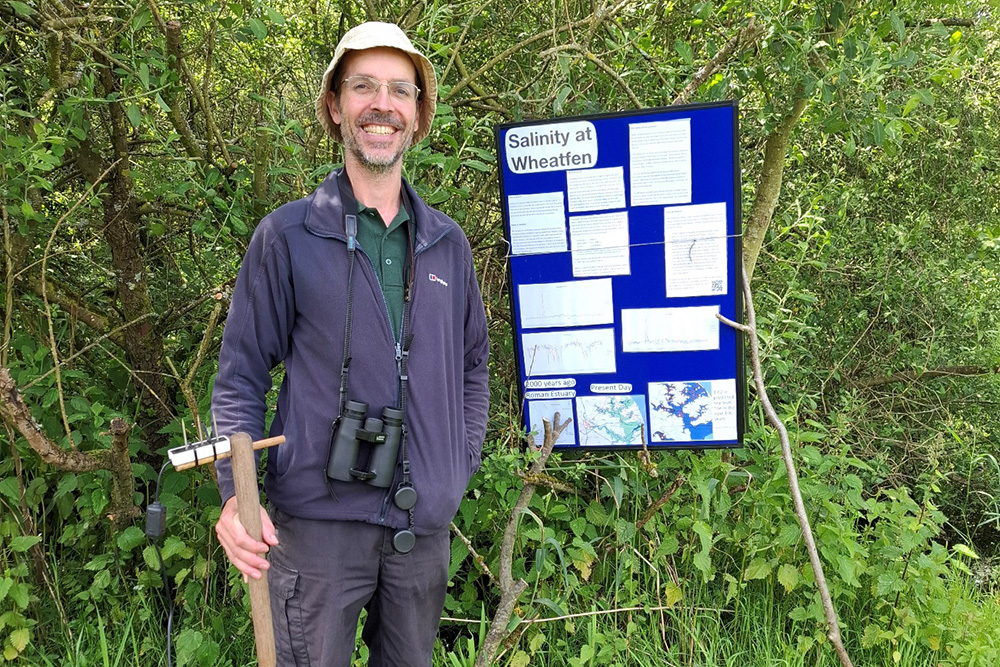
Visitors to Wheatfen may sometimes catch a glimpse of one of the reserves more secretive creatures, mensor salsus.
One of our Volunteers (and the author of this blog) Stuart
This diurnal mammal will often be found deep in the fen or amongst the willows of the carr woodland, but when encountered on one of the reserve’s paths it will often be moving at speed before disappearing once more into reedbed or carr. Just occasionally mensor salsus has been spotted consuming food in the open, but more usually it appears to survive by taking water from the reserve’s waterways.
In 2017 researchers from Royal Holloway University (RHU) and Leeds University (LU) teamed up with the Ted Ellis Trust to launch the Broadland Ecohydrological Observatory (BEO) at Wheatfen. The aim of the BEO is to gather long-term data relating to the impact of meteorological conditions, and ecological and hydrological changes, on semi-natural wet woodland. A range of tests, samples, surveys and monitoring is carried out by teams from RHU and LU, through both automated measuring and in-person fieldwork.
Since 2021, as part of the BEO testing regimen, a fortnightly manual survey of salinity levels has been conducted. I started volunteering at Wheatfen in about 2019 and started doing the salinity survey regularly in 2021/22. Will sometimes also adds in an extra survey if there has been a particularly high tide or flood event.
It takes me between 90 minutes and two hours to visit the eleven survey points spread across the reserve … the exact time taken will depend on the going underfoot, wildlife encountered, and the number of refreshment breaks. Whilst five of the survey points are accessed immediately from public paths, the other six require varying levels of intrepidness to reach, especially in winter conditions. I carry with me a meter (a small box of electronics with a digital display) which is connected to a multi-pronged probe cable-tied to the end of a broom handle (cutting-edge science and rusticism meet here!). I also carry a clipboard to note down the results (and a pencil and watch). At each point I record moisture, salinity, temperature and time.
To take a reading the process varies depending upon the survey point, at open water sites I lean out over the water to insert the probe into the water about 1 metre from the bank and about 300mm below the surface. On ‘dry’ land it is a simple case of pushing the needles of the probe into the soil/mud. Once in place, the meter unit is switched on, and the readings are recorded. There is a thermistor inside one of the needles for temperature, while for moisture and salinity (based on electrical conductivity) the resistance of alternating electrical current between two of the probe’s needles is measured.
Why is rising salinity a problem? We have about three years’ worth of data now, still early days as far as the overall research project is concerned, and when put into graph form the levels all look to be fairly steady apart from one significant but brief peak in early 2022. The readings we take are measured in decisiemens per metre (dS/m), with results at Wheatfen generally ranging between 0.3ds/m and 1.4ds/m (depending upon survey point and time of year; temperature also has an impact on readings). To put these numbers into context, ‘Fresh Water’ is up to 0.8ds/m and becomes ‘Slightly Brackish’ at 1.7ds/m … ‘Sea Water’ is about 50ds/m. Humans can’t tolerate consumption of water above 2.5ds/m. From about 2ds/m upwards, plants begin to become sensitive to the conditions, and this is where it has particular relevance for freshwater sites such as Wheatfen.
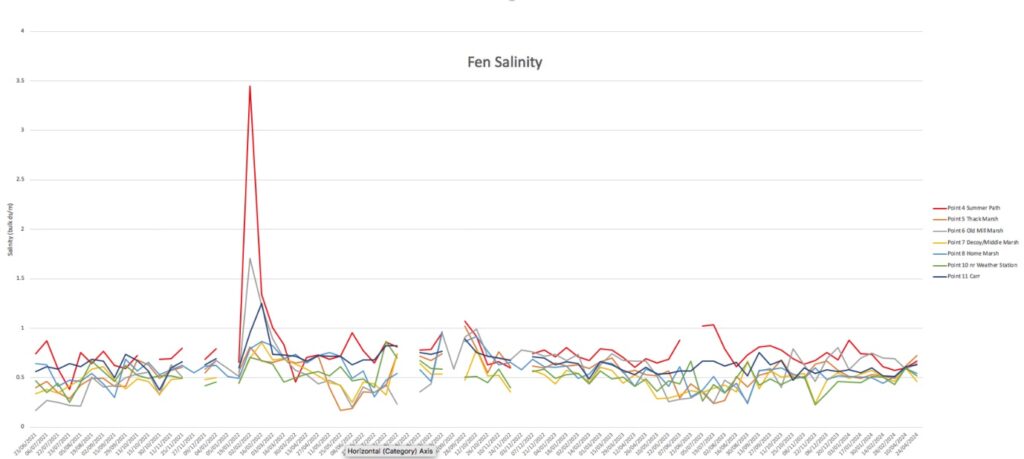
The fen salinity graph for Wheatfen
Many key plant species of The Broads are not salt tolerant, milk parsley (Peucedanum palustre) is one such plant. Milk parsley is the foodplant of the swallowtail butterfly (Papilio machaon Britannicus) larvae, so if we lose that plant to increased salinity, we’ll also likely lose the butterfly. With rising sea levels and significant high tides more salt reaches the reserve via the tidal River Yare, but because of the management of the dykes and ditches at Wheatfen, tidal water finds its way as quickly off the reserve as it does onto it … there is limited opportunity for the salt to permeate the soil. So, for now, this approach seems to be keeping salinity in check. The sort of long-term data being gathered at Wheatfen, and other sites is crucial in backing up such management decisions, whilst also providing an early warning system if conditions begin to change.
I enjoy doing the salinity survey, it’s much easier than the fauna surveys as the salt doesn’t move around too much! I’m intrigued by the ‘hidden’ elements that contribute to the dynamic of the world around us; along with salinity the BEO has plenty more to offer in this respect, particularly around the carbon capture/storage potential of wet woodland.
Well, that’s enough of the science! Although I’m contributing to the work of Wheatfen and to the research into rising salinity levels, I do feel lucky to be doing this surveying. It’s like having a backstage pass to the reserve, I get to visit parts of the reserve not open to the public. Having said this, it’s often on the public paths that I have had the most memorable encounters with wildlife. One morning, my son had accompanied me on a survey trip, and we were sat chatting on the bench at the end of the Smee Loke path, suddenly a thundering noise came from the Summer Path … an otter trotted past us, a couple of feet away and carried on up Smee Loke. We were way more surprised than the otter, we shot in the air, landed dumbfounded and completely missed the opportunity of a photo.
It’s also lovely to see the reserve in its year-round glory. Of course, it’s great to be at Wheatfen in spring and summer but I really do enjoy the place in winter when things can become a bit more challenging. Cracking through sheets of ice on Home Marsh or racing an incoming high tide that will submerge already saturated paths. Stood amidst Thack Marsh, knee-deep in water, it is easy to forget that I’m in one of the more benign British landscapes, and only a few miles from the centre of Norwich. It’s good thinking time and makes you feel alive!
If you encounter mensor salsus when you are visiting Wheatfen, why not stop for a chat.